
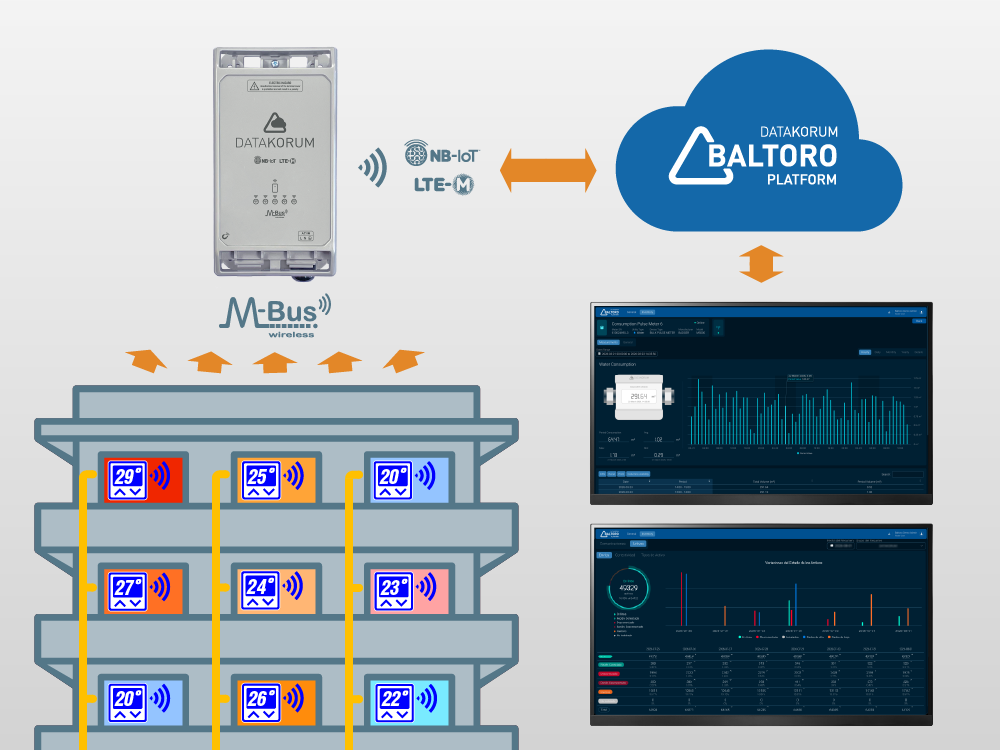
How to implement remote meter reading in buildings and housing estates without replacing the existing infrastructure
The real challenge is no longer measurement. It is managing information.
In recent years, the digitalisation of buildings has seen significant growth. It is becoming increasingly common to find owners’ associations, office blocks, hotels, hospitals and residential complexes fitted with individual meters for water, heating, gas and electricity.
However, having the measuring equipment is only the first step.
The real challenge begins when all that information needs to be turned into a useful tool for day-to-day management.
In many buildings, meter readings still rely on manual processes, regular site visits or isolated systems, which make it difficult to gain an overall view of the property. As a result, data arrives late, requires manual processing and limits the ability to detect incidents or make informed decisions.En muchos edificios, la lectura de consumos continúa dependiendo de procesos manuales, visitas periódicas o sistemas aislados que dificultan la obtención de una visión global del inmueble. Como consecuencia, los datos llegan tarde, requieren tratamiento manual y limitan la capacidad de detectar incidencias o tomar decisiones fundamentadas.
The question is no longer whether we should measure consumption.
The question is how to do this efficiently, automatically and on a scalable basis.
When measuring isn’t enough
Let’s imagine a residents’ association with 180 flats.
Each property has its own water meter and cost allocators for heating.
The infrastructure is in place.
The devices are working properly.
However, each reading requires manual intervention or regular processes that take up time and resources and generate a significant amount of administrative work.
In this scenario, the problem does not lie in the measurement.
The problem lies in the management of information.
The larger the building, the greater the number of devices that need to be monitored, and the greater the complexity involved in consolidating all that information in a reliable and consistent manner.
From the meter to the data
The difference between a conventional installation and one designed for smart management lies not only in the meters installed.
It lies in the ability to retrieve information automatically and make it available to those who need it.
Remote meter reading makes it possible to automate this process.
Rather than relying on manual reading campaigns, the devices periodically transmit the information to a communications infrastructure that centralises all the data and makes it available to the management platform.
This change completely transforms the way we operate.
Information ceases to be a historical record and becomes a tool for ongoing management.
An upgrade without replacing the entire system
One of the main concerns when undertaking a digitisation project is often the investment required to adapt existing facilities.
The reality is that, in many cases, there is no need to replace devices that are already installed.
Buildings that already have meters or sub-meters compatible with Wireless M-Bus can make use of that infrastructure and move towards a remote meter reading model by installing a gateway capable of automatically collecting all the data and transmitting it to the management platform.
This approach makes it possible to safeguard the investment made, reduce implementation times and minimise the impact on the building’s users.
An infrastructure ready for growth
Automating reading does more than just reduce travel.
It also creates a technological foundation that is ready to evolve.
Using the information collected, it is possible to generate consumption history reports, detect anomalies, set up alarms, analyse trends or integrate the data with other energy management tools.
Information is no longer scattered across multiple devices but becomes a centralised asset that facilitates decision-making.
Benefits for each profile
Property managers
Having centralised information reduces the administrative burden, makes it easier to draw up consumption allocations and improves transparency for property owners.
Maintenance companies
Remote meter reading makes it possible to monitor installations without unnecessary travel, identify issues at an early stage and plan actions more efficiently.
Utilities and service providers
Automating meter reading reduces operating costs, improves data quality and simplifies the management of large fleets of devices.
System integrators
Working with open standards and compatible devices makes it easier to design scalable solutions tailored to the specific needs of each project.
Where does it add the most value?
Remote meter reading solutions can be used in any building where there are multiple individual meter readings.
The most common cases include:
-
-
-
- Homeowners’ associations.
- Hotels and holiday resorts.
- Hospitals and healthcare centres.
- Care homes and care centres.
- Office buildings.
- University campuses.
- Sports facilities.
- Shopping centres.
-
-
In all these cases, having up-to-date information helps to improve operational efficiency and optimise resource management.
Beyond meter readings
Remote meter reading is not simply a matter of replacing a manual reading with an automatic one.
Its true value lies in transforming thousands of individual records into useful information to help manage a building more effectively.
When data is collected automatically, it can be analysed, compared and used to identify issues, optimise consumption and provide a better service to property owners, managers and operators.
The digitalisation of buildings does not begin with a gateway, nor does it end with a meter.
It begins when data ceases to be isolated and starts to generate knowledge.
And it is precisely this ability to transform information into decisions that sets a conventional building apart from one that is equipped to meet the challenges of energy management in the future.

Would you like to find out how to automate meter readings in your building or housing estate?
Discover the PIPE20HUBWM solution and how it can be integrated with existing Wireless M-Bus devices to turn consumption data into a management tool.


