
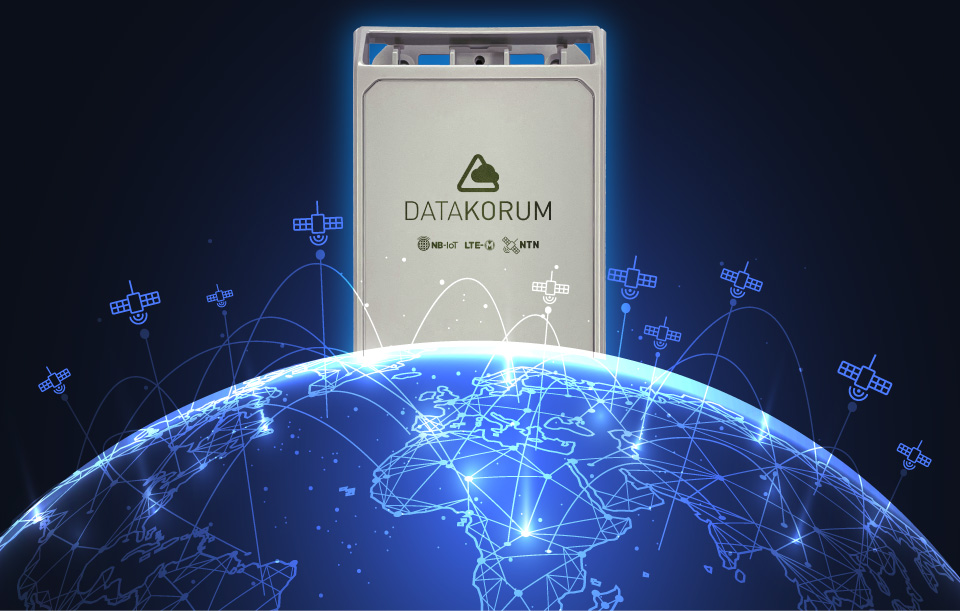
The New Era of IoT: Global Connectivity Through 5G Terrestrial and Satellite NTN Networks
Since its foundation in 2014, Datakorum has pursued a clear vision: low-power wide-area mobile networks such as NB-IoT would become the key enabler for a new generation of IoT solutions designed for critical infrastructure. This conviction led us to design and deploy our own gateways and execute large-scale projects in essential sectors such as water, energy, and mobility.
Over the last decade, this approach has allowed us to obtain reliable, continuous data from hard-to-reach locations —underground chambers, basements, rural zones or remote facilities— enhancing operational efficiency and sustainability for numerous organisations.
Today, the IoT landscape is entering a new phase. The convergence of 5G terrestrial networks and Non-Terrestrial Networks (NTN) is unlocking truly global NB-IoT coverage, greater network resilience and a comprehensive connectivity model that overcomes conventional geographic limitations.
A structural shift in IoT telecommunications
While 5G deployment is progressing rapidly, only 10% of the Earth’s landmass has terrestrial mobile coverage. The remaining 90% —rural areas, linear infrastructure, forestry regions, mountainous terrain, or maritime environments— still requires reliable connectivity for the monitoring of critical assets.
NTN technologies emerge specifically to close this gap.
The combination of 5G + NTN does more than extend coverage: it redefines the standards of continuity, availability and redundancy expected from industrial IoT networks.
What is NTN and why is it so relevant for IoT?
Non-Terrestrial Networks (NTN) comprise all communication systems that operate above the Earth’s surface, including:
Low Earth Orbit (LEO) satellites
Medium Earth Orbit (MEO) satellites
Geostationary (GEO) satellites
High-Altitude Platform Stations (HAPS)
Unmanned Aerial Vehicles acting as communication relays
These technologies provide coverage where terrestrial infrastructure cannot be deployed, enabling near-continuous service without the need for towers, repeaters or fibre networks.
The critical evolution: integration with the 3GPP standard
Until now, NB-IoT devices have had to choose between cellular or satellite communication through additional hardware.
With the advances introduced in 3GPP Release 17, devices will be able to connect natively to both terrestrial and satellite networks, without external modules.
In practice, satellites will operate as base stations in the sky, extending 5G beyond any geographical boundary.

Technological evolution: NTN-IoT and NTN-NR
NTN technologies are evolving along two main paths:
1. NTN-IoT (the current market leader)
Designed for IoT devices transmitting small amounts of data, focused on:
- Critical infrastructure supervision
- Remote meter reading (water, energy, gas)
- Environmental and agricultural sensors
- Distributed industrial equipment
Operating mainly through LEO and GEO satellites, it delivers global coverage at optimised cost.
2. NTN-NR (the next major step)
Intended to connect smartphones, routers and 5G gateways directly to LEO satellites, enabling:
- Messaging and low-rate voice services in remote locations
- Higher-bandwidth IoT applications
- Operational continuity in mobility scenarios (maritime, rail, highways)
Together, both variants create an ecosystem in which any asset, anywhere, can transmit data reliably and without dependence on terrestrial infrastructure.
Why satellite connectivity now fits perfectly with IoT?
atellite communications were historically expensive and unsuitable for low-power IoT applications.
The landscape has changed dramatically due to three key factors:
- New LEO constellations reaching global scale.
- Full integration with 3GPP standards for NB-IoT.
- More efficient, compact and affordable hardware.
The outcome is a new operational model:
global IoT connectivity, high availability, and a low total cost of ownership —all essential requirements for utilities and critical infrastructure operators.
The 5G + NTN convergence: towards truly uninterrupted connectivity
NB-IoT and LTE-M technologies have proven ideal for devices that require:
- Low transmission rates
- Long-lasting autonomy
- Deep indoor and underground penetration
- Long-range communication
However, terrestrial networks have a well-known limitation: coverage gaps can interrupt data transmission, resulting in operational blind spots, lost packets and inefficiencies.
The convergence of 5G terrestrial networks and NTN satellite networks resolves this challenge.
Key benefits of this integrated approach:
- Genuine global coverage
Sensors and meters can operate reliably in any geographical setting —from long-distance pipelines to isolated agricultural fields. - Built-in redundancy for critical infrastructure
If terrestrial coverage weakens, devices automatically switch to satellite connectivity, ensuring uninterrupted service and data integrity. - Higher operational resilience
Data continues to flow even in adverse conditions such as natural events, power outages or terrestrial network failures. - Superior data reliability
Stable and predictable transmission enhances operational decision-making and strengthens predictive maintenance models.
Practical applications: sectors that benefit immediately from 5G–NTN convergence
Utilities and distribution networks (water, energy and gas)
Reliable data transmission is vital for:
- Detecting leaks or commercial losses
- Monitoring pressures and consumption
- Supervising smart meters
- Managing pumps, valves and remote stations
- 5G–NTN connectivity ensures that no operational event goes unreported, improving safety and extending the lifespan of infrastructure assets.
Smart agriculture and irrigation management
Meters, valves, pumps and actuators gain:
- Guaranteed coverage across the entire plot
- Greater control and accuracy
- Reduced water and energy losses
- Fewer site visits and operational costs
Environmental monitoring in remote locations
Sensors capturing:
- Air quality
- Water levels
- Soil parameters
- Climate risk indicators
- can now transmit data in real time from isolated areas, supporting better planning and faster emergency response.
De la innovación a la ejecución real

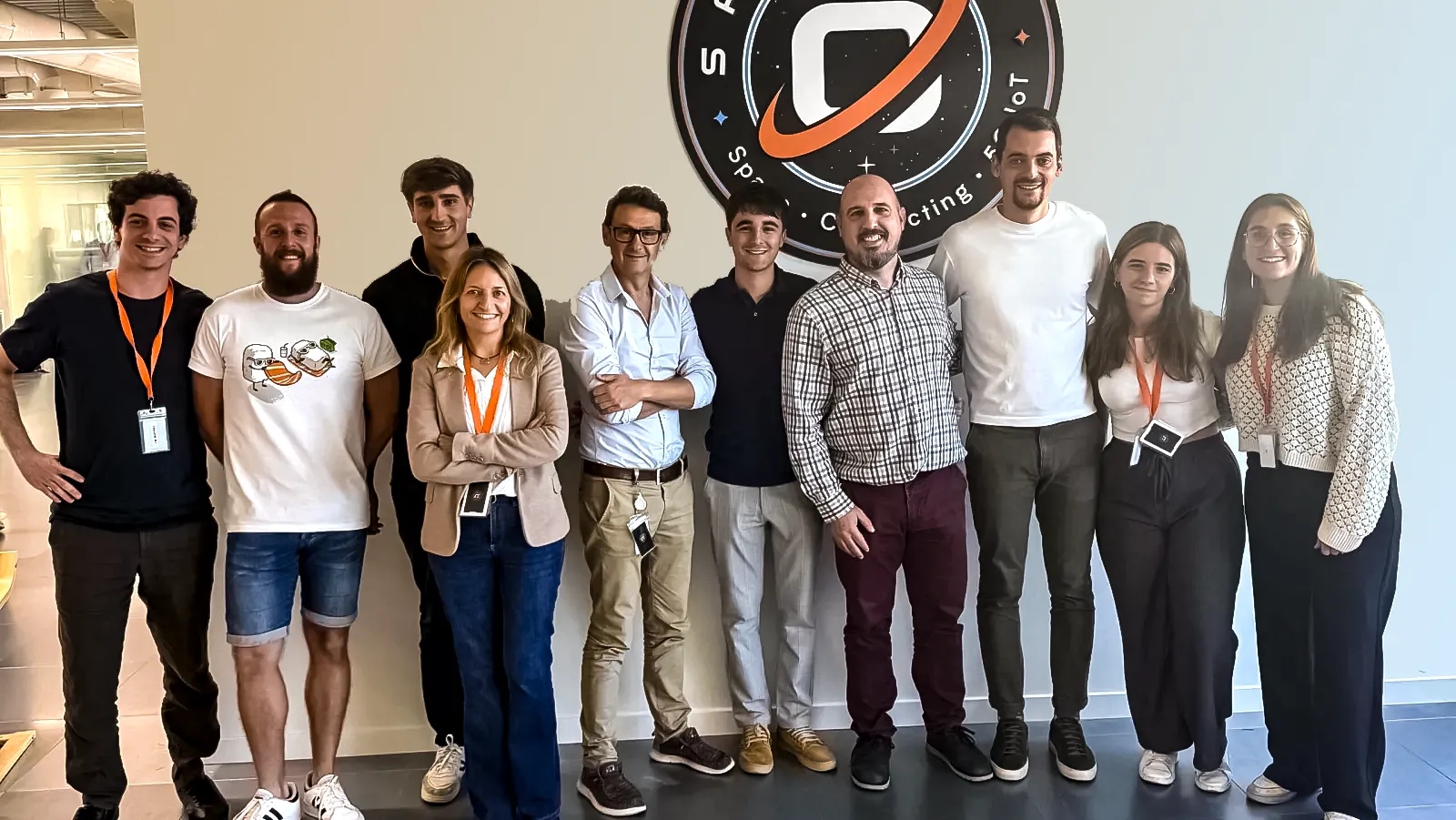
Datakorum’s commitment to convergence between 5G terrestrial networks and non-terrestrial networks (NTN) is not new. Over recent years, this approach has been validated both in real projects and in international innovation initiatives. In this context, our participation in 2024 in the Satellite NB-IoT Early Adopter Programme promoted by Deutsche Telekom, Skylo and Murata was recognition of the technical work carried out by our team and our early vision of satellite IoT.
Today, that path is evolving into a new stage, marked by the recent strategic alliance between Datakorum and Sateliot. This collaboration represents a decisive step towards taking NB-IoT connectivity beyond the limits of terrestrial networks, natively integrating 3GPP-based satellite communications into industrial IoT solutions.
Thanks to this alliance, organisations that manage critical infrastructure will have access to a truly global, robust and energy-efficient connectivity ecosystem capable of ensuring operational continuity even in environments without cellular coverage. This is a particularly significant development for sectors such as water, energy, gas, agriculture, mobility and environmental monitoring.
The convergence between terrestrial 5G and satellite connectivity is no longer a vision of the future. It is a reality in the making, and at Datakorum we continue to work to ensure that this reality translates into accurate, reliable and actionable data, wherever it is most needed.


